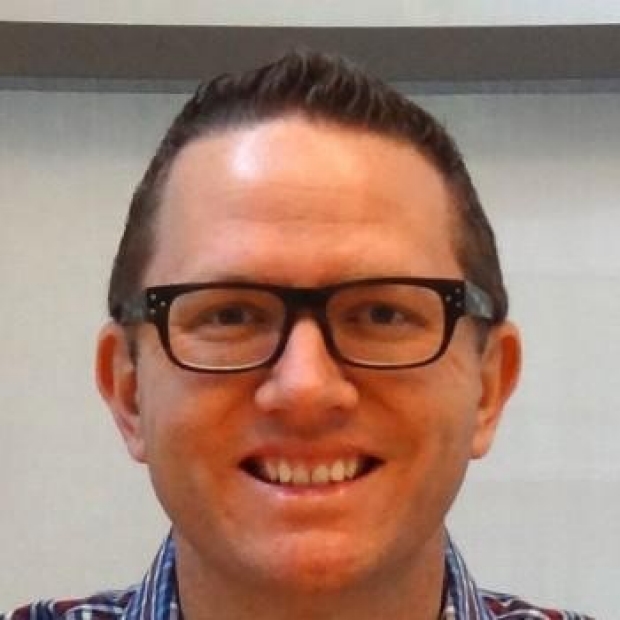
Dr. Graves is an associate professor in the Medical Physics Division of the Stanford University School of Medicine Department of Radiation Oncology.
Faculty Spotlight: Ted Graves, PhD
Ted Graves arrived in the world of radiation oncology unconventionally: his background is in bioengineering, primarily, with an emphasis on molecular imaging. He never set out to arrive in the field, necessarily, but has carved out a unique area of research for himself within it.
“I was the imaging guy who was interested in looking at radiation therapy but not having done any radiation physics,” remembered Graves.
He arrived at this junction by following his passion for science at the molecular level. Graves was surrounded by science in the home as a child; his parents, both former chemists, embedded a lifelong fascination and fostered an environment that supported it.
Graves’s first brush with biology was in high school, but he knew very early on that this newfound focus was not to be translated into being a doctor. He was more interested in the mechanisms behind the medicine, rather than administering it himself. When it came time to apply for college, he followed biology to University of California Berkeley, where he received his undergraduate degree in bioengineering, though not being 100% certain of what the subject actually was until receiving his acceptance letter.
“I remember I had an appointment and went to a counselor at Berkeley and asked ‘what is bioengineering? What did I apply to?’ As luck would have it, it was fortuitous,” said Graves. Bioengineering turned out to be the perfect intersection between biology and the technical side of physics that he was looking for. As his college tenure came to an end, he started looking for next steps, and landed on continuing a path of research.
“I had gotten interested in medical imaging, just the idea that you could acquire images of what people looked like on the inside noninvasively,” he said.
After Berkeley, Graves continued his studies at University of California San Francisco, where he was fully indoctrinated into the realm of molecular biology and imaging by joining the school’s Magnetic Resonance Science Center. There, he utilized magnetic resonance spectroscopy to study brain tumors and their response to radiotherapy, and solidified his love for the field. At UCSF, he made strong bay area connections with colleagues in the field, like visionary radiologist Sarah Nelson, who eventually helped him secure a position at Stanford after Graves completed his postdoctoral training at Massachusetts General Hospital.
As part of his interview at Stanford, Graves gave a research talk to the radiation oncology department. A Golden Bear, he was nervous about crossing this age-old rivalry: “Coming from Berkeley, I was already indoctrinated in the ‘Stanford was the devil’ mentality,” he joked. But none of that mattered, and he found a permanent home on the Farm. Prior to, his work was primarily focused on radiology with collaborations with radiation oncology here and there. He thought at Stanford his modus operandi wouldn’t be much different. Instead, Graves found himself jumping the fence over to radiation oncology, a decision supported by the late Sam Gambhir, MD, PhD, who welcomed Graves into his newly minted molecular imaging program.
“[Sam] told me all about this molecular imaging program at Stanford that he was going to start, and about getting me in on the ground level. That was really a big positive, and also helped some of the culture shock,” he explained. “Coming into radiation oncology, an environment I’m not as familiar with, I’ve got this strong supporter in Sam, who is doing all this cool stuff in radiology. He came and left a huge impact on the department and the program.”
As time progressed, Graves found himself straddling the niche between radiology and radiotherapy, collaborating with both areas to create enhanced visualization techniques for a better understanding of cancer biology. It was a process to find out where his research truly lay in space and in time, something that he grappled with for a while.
“I remember doing this soul searching and thinking ‘do I need to just reinvent myself and become a radiation physicist, because that’s where I am?’,” he remembered. “The phrase that always sticks in my mind comes from what I wrote down in my notebook at some point: ‘I don't care how the dose gets there, I care about what it does.’ That crystallized I wanted to study, how radiation factored into that and how it gets there. That’s something else.”
While he was scientifically interested in cancer and radiation, it was still “just a day job.” That is, until Graves was diagnosed with thyroid cancer in 2012, turning his world upside down, and reframing his entire relationship with the disease and his work as a whole.
“That changed everything. I got to find out what patients actually go through,” he said. “Suddenly there’s a personal element: looking at a survival curve and thinking ‘I have an X% chance of surviving five years after treatment.’ It’s a whole different thing. You get a different kind of motivation.”
It was then that Graves was able to consider the big picture in a way he hadn’t before- the work that he was doing connected to the clinical side of things shed light on a newfound purpose. And after being cancer free for over 10 years, he has found a balance between academic and hippocratic inspiration. Today, he is an associate professor in the department of radiation oncology and principal investigator of the Graves lab. He continues to focus his efforts on understanding the relationship between radiation and cancer biology, and improving treatment of human disease.
To learn more about Graves’s research, visit the Graves Lab.